When customers talk to a chatbot, they are not just talking to software. They are meeting your brand in real time. A clear, confident bot voice turns that moment into a powerful advantage: faster answers, happier customers, and better business results.
This guide shares tips for boosting agent productivity with AI by showing how a strong bot voice can assist human agents, enhance customer conversations, and improve overall service efficiency. By boosting agent performance with AI tools, organizations can leverage the power of cloud-based AI platforms, advanced machine learning, and computer technology to automate repetitive tasks, manage large volumes of data, and provide smarter insights for decision-making.
Across industries, AI is reshaping the way businesses operate. In marketing, digital marketing powered by artificial intelligence and predictive analytics enables companies to create personalized campaigns, optimize content distribution, and track audience engagement in real time. Similarly, marketing strategies using AI-driven customer behavior analysis help brands deliver highly targeted promotions and improve conversion rates, connecting every interaction to meaningful business outcomes.
In finance, intelligent financial services powered by AI and data analytics allow firms to detect fraudulent activity, assess credit risk, automate reporting, and make faster investment decisions. AI-powered platforms in banking, investment, and insurance sectors help organizations reduce operational errors, improve customer trust, and increase efficiency.
By integrating these technologies - cloud computing with AI, machine learning in computer systems, AI-driven marketing campaigns, and financial intelligence powered by artificial intelligence—with a consistent bot voice, businesses can create a seamless, engaging, and data-informed experience for every customer. Each interaction becomes not only a support opportunity but also a strategic touchpoint that strengthens your brand, builds customer loyalty, and drives measurable growth across digital, financial, and operational channels.
Top Contact Center Solutions with AI and Bot Voice
When it comes to enhancing customer experiences and agent productivity, AI-powered contact center solutions are leading the way. A strong bot voice can make every interaction seamless, providing faster responses, better engagement, and actionable insights. Here’s a list of the top 10 platforms helping businesses transform customer service.
1. Bright Pattern
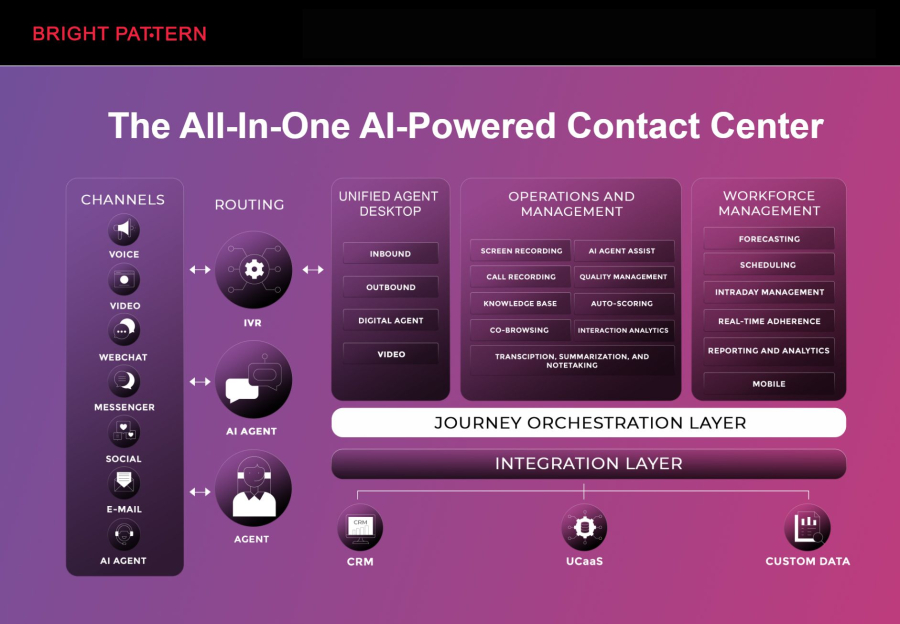
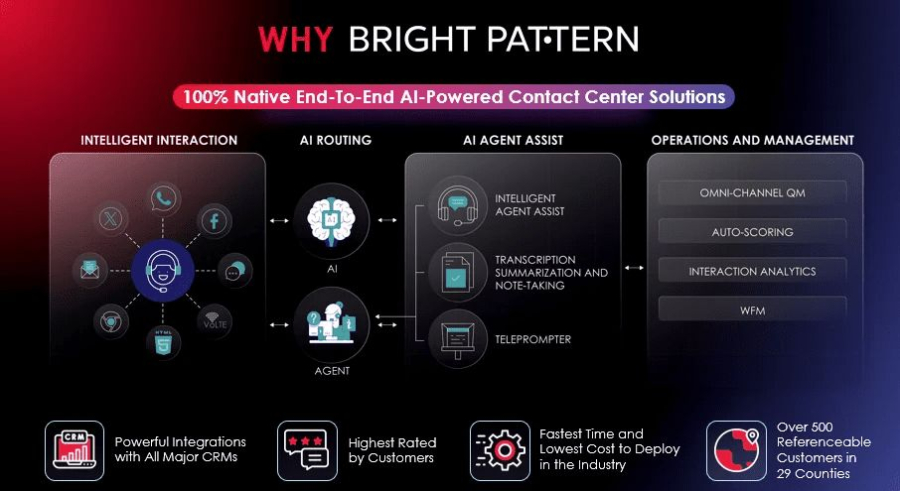
Bright Pattern is a leading AI contact center solution designed to optimize customer engagement across all communication channels. Its platform empowers organizations to create seamless experiences using a natural bot voice, intelligent routing, and advanced analytics. Bright Pattern helps businesses reduce response times, improve agent efficiency, and deliver personalized service.
Key features include:
- AI-powered chatbots and voice assistants for 24/7 customer support
- Omnichannel engagement: voice, chat, email, SMS, social media
- Intelligent call routing based on customer history and preferences
- Cloud-based architecture for scalability and remote agent support
- Advanced reporting and analytics for performance tracking
- Integration with CRM, marketing automation, and AI tools
With Bright Pattern, businesses can boost agent performance with AI tools and enhance every customer touchpoint with a clear, confident bot voice that aligns with their brand identity.
2. Genesys
Genesys offers an AI-driven contact center platform that focuses on personalized customer interactions and automated agent assistance. Its AI tools help optimize workflows and provide data-driven insights.
3. Five9
Five9 provides cloud-based call center software with AI capabilities such as predictive dialing, virtual agents, and sentiment analysis to improve customer satisfaction and agent efficiency.
4. NICE inContact
NICE inContact CXone delivers a comprehensive AI contact center solution with omnichannel support, analytics, and automation features that enhance both customer experience and agent productivity.
5. Avaya
Avaya OneCloud CCaaS combines AI, automation, and cloud computing to offer intelligent routing, self-service options, and analytics-driven decision-making for contact centers.
6. RingCentral
RingCentral Contact Center leverages AI and machine learning to streamline interactions, improve agent guidance, and provide actionable insights across multiple channels.
7. Talkdesk
Talkdesk offers AI-powered call center software with automation, virtual agents, and analytics that help organizations deliver efficient, consistent, and engaging customer experiences.
8. 8x8
8x8 X Series integrates AI-driven analytics, virtual assistants, and omnichannel communications to improve contact center efficiency and customer satisfaction.
9. Cisco Contact Center
Cisco provides AI-enhanced solutions that combine machine learning, speech analytics, and intelligent routing to improve both customer interactions and agent performance.
10. Zendesk
Zendesk’s AI-enabled customer service platform includes bots, automation, and predictive analytics to streamline support processes and enhance customer engagement.
What Is a Bot Voice?
Yourbot voiceis the consistent way your chatbot communicates in every interaction. It includes:
- Tone– How the bot sounds (friendly, professional, playful, concise).
- Language style– The words, phrases, and sentence length it uses.
- Personality– The subtle traits that make it feel distinct and on brand.
- Behavior– How it greets, clarifies, apologizes, and closes conversations.
Think of bot voice as your brand's communication guidelines translated into automated conversations. Instead of a random mix of replies, every response feels intentional, clear, and familiar.
Why Bot Voice Matters for Your Business
A well defined bot voice is more than a cosmetic choice. It directly affects your bottom line in several ways.
1. Higher Customer Satisfaction
Customers do not just want answers; they want answers that feelhuman awareand respectful of their time. A strong bot voice does this by being:
- Predictable– Customers quickly understand how to interact with the bot.
- Empathetic– The bot acknowledges frustration, confusion, or urgency.
- Action oriented– Replies guide users to clear next steps.
The result is lower perceived effort for the customer and higher satisfaction scores for your team.
2. Faster Resolution and Lower Support Costs
When a bot voice is clear and direct, customers resolve issues faster. That means:
- Fewer repeated questions.
- Less confusion about what to do next.
- More issues solved without human escalation.
The more accurate and self explanatory each response feels, the more your chatbot can handle routine work, freeing human agents to focus on complex or high value conversations.
3. Stronger Brand Consistency
Every interaction is a branding moment. A scattered bot voice creates friction: one message is casual, the next is formal, another feels robotic and cold. A consistent voice, on the other hand, reinforces who you are as a company, every time the bot responds.
Customers begin to trust that your brand will speak to them clearly, respectfully, and reliably. That trust fuels repeat business, referrals, and long term loyalty.
4. Better Conversion and Revenue
With the right bot voice, chatbots do more than answer questions. They guide customers toward outcomes that benefit them and your business:
- Helping visitors choose the right product or plan.
- Rescuing abandoned carts with timely, friendly prompts.
- Upselling or cross selling when it is clearly helpful.
- Capturing qualified leads with low friction questions.
When the bot sounds confident, transparent, and helpful, customers feel safe taking the next step.
Key Elements of a High Performing Bot Voice
To design a bot voice that delivers measurable benefits, focus on a few core elements.
1. Clarity Above All
Clarity is the greatest strength of a bot voice. Users should instantly understand:
- What the bot can and cannot do.
- What information it needs from them.
- What will happen after they respond.
Practical ways to keep your bot voice clear:
- Useshort sentencesandplain language.
- Avoid jargon unless your audience uses it daily.
- Break multi step instructions into ordered lists.
- Confirm important details back to the user.
2. Friendly, Respectful Tone
A benefit driven bot voice respects users' time and emotions. It can be warm and upbeat without overdoing personality. Strong tones often share these traits:
- Politebut not overly formal.
- Encouragingwhen users are stuck.
- Calmwhen handling complaints or complex issues.
For example, instead of saying, “Invalid input,” a friendly bot might say, “I could not match that to a valid option. Let us try again with one of these choices.”
3. Transparent About Being a Bot
Users appreciate honesty. A modern, effective bot voice does not pretend to be human. Instead, it highlights strengths:
- Instant access to account information.
- 24/7 availability.
- Fast routing to the right human when needed.
A clear, transparent introduction might sound like:
Hi, I am your virtual assistant. I can help you check orders, update account details, or connect you to a specialist. What would you like to do today?
4. Consistent Personality
Personality gives your bot voice a memorable flavor. You do not need jokes or slang to be engaging. Instead, define a few stable traits, such as:
- Supportiveand solutions focused.
- Curiousabout understanding the user's goal.
- Data drivenwhen explaining options or tradeoffs.
These traits can guide how the bot phrases replies, asks follow up questions, and handles uncertainty.
Designing Your Bot Voice Step by Step
You can shape a powerful bot voice with a clear process. Here is a straightforward framework.
Step 1: Align With Brand and Business Goals
Before writing any responses, connect your bot voice to your brand and objectives. Ask:
- What three words describe our ideal brand voice?
- Who are our primary users, and what do they expect?
- What does success look like for our chatbot: fewer tickets, more sales, faster onboarding?
Translate these answers into guardrails. For example:
- Voice: clear, confident, friendly.
- Do: simplify choices, summarize next steps, highlight benefits.
- Do not: use sarcasm, argue with users, or overpromise outcomes.
Step 2: Define Conversation Principles
Conversation principles act like a playbook for the bot. They guide how it responds even in new situations. Strong examples include:
- Always set expectations– Explain what will happen next.
- Ask one question at a time– Reduce cognitive load.
- Offer a clear escape– Let users reach a human or choose another path.
- Summarize decisions– Confirm what is agreed before closing.
Step 3: Create Sample Dialogues
Instead of writing single, isolated replies, map full conversations for your most important use cases. For each one, sketch:
- The user's goal (for example, track an order, reset a password, choose a plan).
- Typical user questions or phrases.
- The ideal end state for the user and the business.
Then write a sample dialogue that shows how your bot voice:
- Greets and sets expectations.
- Asks for the right information.
- Handles confusion or errors.
- Closes with a clear, positive outcome.
Step 4: Standardize Reusable Patterns
High performing bots reuse proven language patterns instead of reinventing every response. Build short libraries for
- Greetings and introductions.
- Clarification questions.
- Apologies and recovery messages.
- Confirmations and summaries.
- Closings and follow ups.
This keeps your bot voice consistent even as you expand to new workflows and channels.
Step 5: Test, Measure, and Refine
A bot voice is not static. It improves with data. Monitor signals such as:
- Completion rates for key flows.
- Drop off points in conversations.
- User ratings or sentiment where available.
- Escalation rates to human agents.
When you see friction, update the wording, not just the logic. Often, a clearer question or more empathetic acknowledgment dramatically improves outcomes.
Examples of Strong Bot Voice Patterns
Below are practical language patterns you can adapt to your own brand, all written in a direct, bot friendly style.
1. Setting Expectations Clearly
Hello, I am your virtual assistant. I can help you with billing, orders, or account changes. Tell me what you need, and I will guide you step by step.
Why it works:
- States what the bot can do.
- Uses simple, actionable language.
- Signals a structured, guided experience.
2. Handling Confusion Gracefully
I am not sure I understood that. Here are a few things I can help with right now: 1. Check an order
2. Update account details
3. Talk to a support specialist Type the number of your choice to continue.
Why it works:
- Admits uncertainty without blame.
- Offers clear next steps.
- Limits choices to reduce friction.
3. Being Direct and Supportive in a Problem Situation
I see you are having trouble with your payment. Let us fix that together. First, I will check the status of your last transaction. One moment while I look that up.
Why it works:
- Acknowledges the issue.
- Signals partnership (“Let us fix that together”).
- Explains what the bot is doing next.
4. Closing With Confidence and Clarity
You are all set. I have updated your delivery address to the new location. If you need anything else, you can ask me here at any time.
Why it works:
- Confirms the action taken.
- Reassures the user the task is complete.
- Invites future use of the bot.
Bot Voice and AI: Making the Most of Intelligent Automation
Modern AI assistants can understand natural language, remember context, and adapt to user intent. A strong bot voice turns that intelligence into a reliable experience.
Guiding AI With Clear Instructions
Behind the scenes, your AI assistant benefits from precise instructions that reflect your bot voice. For example:
- Stay concise and positive.
- Always confirm important decisions.
- Offer a short summary before closing.
These guidelines help AI generate responses that feel consistent, even across new questions.
Balancing Automation and Human Handoffs
A confident bot voice knows when to hand the conversation to a human. It does this transparently and helpfully, for example:
This request needs a specialist on our team. I am connecting you now and sharing what we have already discussed so you do not have to repeat yourself.
This kind of handoff preserves trust and keeps the experience smooth instead of jarring.
Measuring the Impact of Your Bot Voice
To prove the value of your bot voice and keep improving it, track metrics that reflect real outcomes.
Core Metrics to Watch
Metric | What It Shows | How Bot Voice Influences It |
Completion Rate | Percentage of users who finish a flow | Clear steps and instructions reduce drop offs. |
First Contact Resolution | Issues solved in a single interaction | Direct, precise language avoids rework. |
Escalation Rate | Conversations sent to human agents | Better explanations and questions keep more in bot. |
User Satisfaction | Ratings or sentiment after chats | Empathetic, respectful tone raises satisfaction. |
Conversion Rate | Users who complete key actions | Benefit focused messaging guides decisions. |
Using Feedback to Refine Voice
Look for specific language patterns in successful and unsuccessful conversations. For example:
- Phrases that appear often in high satisfaction chats.
- Words or questions that correlate with drop offs.
- Common follow up questions that signal confusion.
Update your bot voice guidelines and templates based on these insights. Over time, your chatbot becomes sharper, more reliable, and more aligned with real user expectations.
Putting It All Together: A Bot Voice That Drives Results
A strong bot voice is not about sounding cute or robotic. It is about delivering consistent, confident, benefit driven communication at scale. When you combine a clear voice with capable AI, you unlock:
- Faster, easier support for customers.
- Lower operational costs for your business.
- Stronger brand trust in every interaction.
- Higher conversion and revenue from existing traffic.
By treating your bot voice as a strategic asset, you turn every automated reply into a small but powerful proof of your brand's reliability. That is how a well designed bot voice transforms from a simple feature into a driver of long term growth.
If you build your chatbot with clarity, empathy, and consistency at the core, your customers will feel it in every conversation—and your business will feel it in the results.
